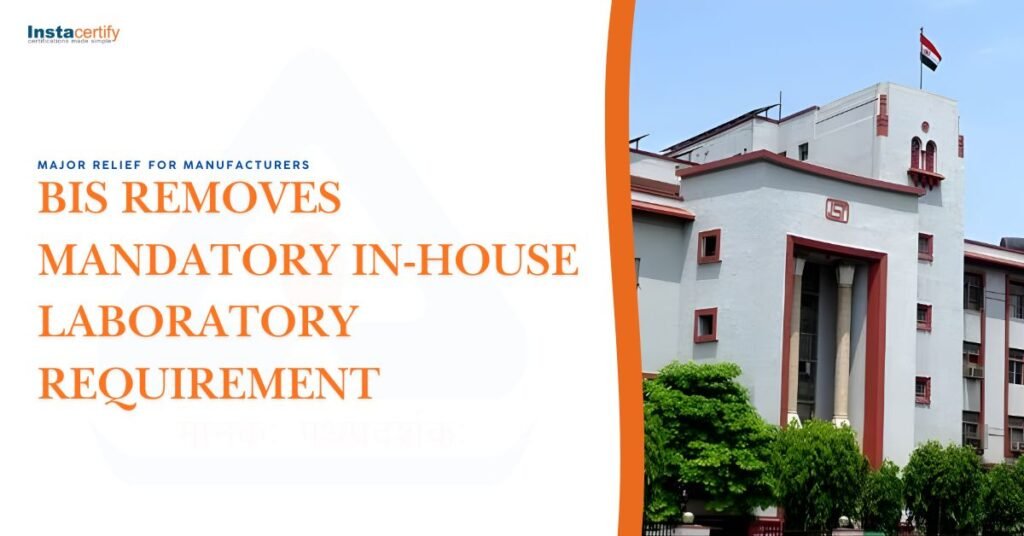
In a landmark move aimed at boosting the “Ease of Doing Business” in India, the Bureau of Indian Standards (BIS) has officially removed the mandatory requirement for manufacturers to maintain an in-house laboratory for product certification.
This update, issued via circular CMD-I/2:6:2 on December 16, 2025, marks a significant shift in the BIS Product Certification Scheme, providing much-needed flexibility to domestic and foreign manufacturers alike.
What Has Changed?
Previously, one of the primary hurdles for obtaining a BIS license (ISI Mark) was the compulsory establishment of a fully equipped in-house testing facility. Manufacturers had to invest heavily in specialized machinery, calibrated instruments, and dedicated space before their license could be processed.
Under the new guidelines, maintaining an in-house laboratory is no longer an obligation. Manufacturers can now fulfill their testing requirements through alternative arrangements, significantly lowering the barrier to entry for new businesses.
New Alternatives for Product Testing
To ensure that product quality remains uncompromised, BIS has introduced flexible testing options. Manufacturers can now opt for:
-
Shared Testing Facilities: Utilizing laboratories shared among multiple manufacturing units.
-
Cluster-Based Testing: Leveraging industry-specific lab clusters established for collective use.
-
External Sub-Contracting: Outsourcing testing to:
-
BIS-recognized or empanelled laboratories.
-
Laboratories accredited as per ISO/IEC 17025 standards.
-
Autonomy in Quality Assurance Plans (QAP)
Beyond the laboratory requirements, the BIS has also updated the Scheme of Inspection and Testing (SIT). The SIT provided in BIS product manuals is now considered recommendatory rather than mandatory.
Manufacturers are now empowered to define and declare their own Quality Assurance Plan (QAP). This allows businesses to design quality control systems that integrate seamlessly with their specific production processes, provided they ensure the final product strictly complies with the relevant Indian Standards.
Important Exceptions
While this relaxation applies to a vast majority of products, it is important to note that certain high-risk or specialized categories are exempted from this rule. Manufacturers in the following sectors must continue to maintain existing testing protocols:
-
Products regulated by DPIIT or PESO (pre-dispatch/lot inspection).
-
Cement products.
-
Food products.
-
Protective Helmets for two-wheeler riders.
-
Products where certification is based solely on factory testing as per specific guidelines.
Why This Matters
This reform is a game-changer for MSMEs and Startups that previously struggled with the high capital expenditure (CAPEX) required for lab infrastructure. By reducing compliance costs and operational burdens, BIS is fostering a more competitive manufacturing landscape while maintaining the high safety standards that the ISI mark represents.
Stay Compliant with Expert Guidance
While the rules have been relaxed, the responsibility to meet Indian Standards remains as strict as ever. Transitioning to a new Quality Assurance Plan or selecting the right external lab requires technical precision.
Instacertify specializes in end-to-end BIS compliance. Whether you need to update your QAP, navigate the new testing alternatives, or apply for a fresh BIS license, our experts are here to help.