Importing products from China into India remains a strong sourcing option, but regulatory compliance now determines how smoothly your goods enter the Indian market. Customs authorities, regulators, and marketplaces expect importers to be fully aligned with documentation, safety, environmental, and labeling requirements.
This guide explains mandatory registrations, EPR certification and its types, LPMC, IEC & ICEGATE, and practical solutions when BIS certification is delayed or not granted under current policy conditions.
Why Compliance Is Critical When Importing from China
Indian regulators actively enforce:
- Quality Control Orders (QCOs)
- Product safety standards
- Consumer labeling rules
- Environmental responsibility obligations
Non-compliance can result in:
- Shipment detention at port
- High demurrage and penalties
- Re-export or destruction of goods
- Restrictions on future imports
Compliance planning should start before finalizing suppliers or placing purchase orders.
Mandatory Registrations & Certifications for Indian Importers
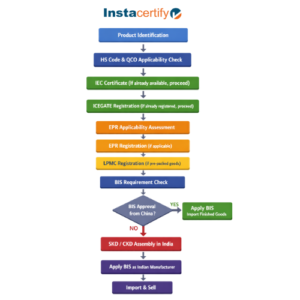
IEC Certificate (Importer Exporter Code)
The IEC Certificate, issued by DGFT, is mandatory to import goods into India.
If you already have an IEC, you are already compliant on this requirement—no additional action is needed.
IEC is required for:
- Importing commercial goods
- Customs clearance
- Foreign remittance through banks
ICEGATE Registration
ICEGATE (Indian Customs Electronic Gateway) registration enables digital interaction with Indian Customs.
If you already have ICEGATE registration linked to your IEC, this step is already completed.
ICEGATE allows:
- Online filing of Bills of Entry
- Electronic duty payments
- Real-time tracking of shipment clearance
IEC and ICEGATE together form the core infrastructure for Indian imports.
LPMC Certification (Legal Metrology – Packaged Commodities)
LPMC registration is mandatory if you are importing pre-packed goods, including:
- Electronics and IT products
- Electrical appliances
- Toys, lighting products, accessories
Mandatory label declarations include:
- Importer name and address
- MRP (₹ inclusive of all taxes)
- Net quantity
- Country of origin
- Consumer care details
Incorrect labeling commonly leads to customs detention or mandatory relabeling at port.
EPR Certification in India & Its Types
Under Extended Producer Responsibility (EPR) regulations, importers are legally treated as producers.
Types of EPR Certification:
E-Waste EPR
For electronics, IT equipment, chargers, adapters
Plastic Waste EPR
For plastic and multilayer packaging materials
Battery Waste EPR
For lithium-ion, portable, and industrial batteries
EPR compliance involves:
- Registration on CPCB portal
- Meeting annual recycling targets
- Engagement with authorized recyclers
BIS Certification: Current Challenges for Imports from China
Many products imported from China require mandatory BIS certification under:
- CRS (Compulsory Registration Scheme)
- ISI Mark Scheme
Current Scenario
- New BIS approvals for China-based factories are highly restricted
- Factory inspections face prolonged delays
- Applications may remain pending for extended periods
This has become a major bottleneck for importers.
What Can Importers Do If BIS Certification Is Not Available?
Option 1: SKD / CKD Imports with Assembly in India (Most Effective)
SKD (Semi Knocked Down) and CKD (Completely Knocked Down) imports allow importers to:
- Import components instead of finished goods
- Assemble or manufacture in India
- Apply for BIS certification as an Indian manufacturer
Advantages:
- Faster BIS approval timelines
- Reduced certification costs
- Better compliance control
- Long-term brand ownership
- Strong alignment with Make in India initiatives
Option 2: Source from Alternate Countries
If SKD/CKD assembly is not feasible:
- Shift sourcing to Vietnam, Thailand, Malaysia, Taiwan, or Indonesia
- Apply for BIS certification for non-China manufacturing units
This approach suits importers seeking fully finished products with fewer regulatory delays.
Option 3: Import Using an Existing BIS Certificate (Limited Scope)
Importers may partner with an entity that already holds a BIS certificate.
Important limitation under CRS:
- New brands cannot be added
- Products must be sold under the existing registered brand
This option is generally viable only for short-term market testing.
Frequently Asked Questions (FAQs)
Q1. I already have IEC and ICEGATE. Do I need to apply again?
No. If IEC and ICEGATE are already active, you can proceed directly with product-specific compliances.
Q2. Can I import from China without BIS certification?
Only if the product is not covered under BIS Quality Control Orders. Regulated products require mandatory BIS approval.
Q3. Is SKD or CKD import legally allowed in India?
Yes. SKD and CKD imports are legally permitted and widely used to overcome BIS approval constraints.
Q4. Is EPR mandatory for importers?
Yes. Importers are treated as producers under EPR rules and must comply accordingly.
Q5. Can I add my brand under someone else’s BIS CRS certificate?
No. Under CRS, new brands cannot be added to an existing certificate.